
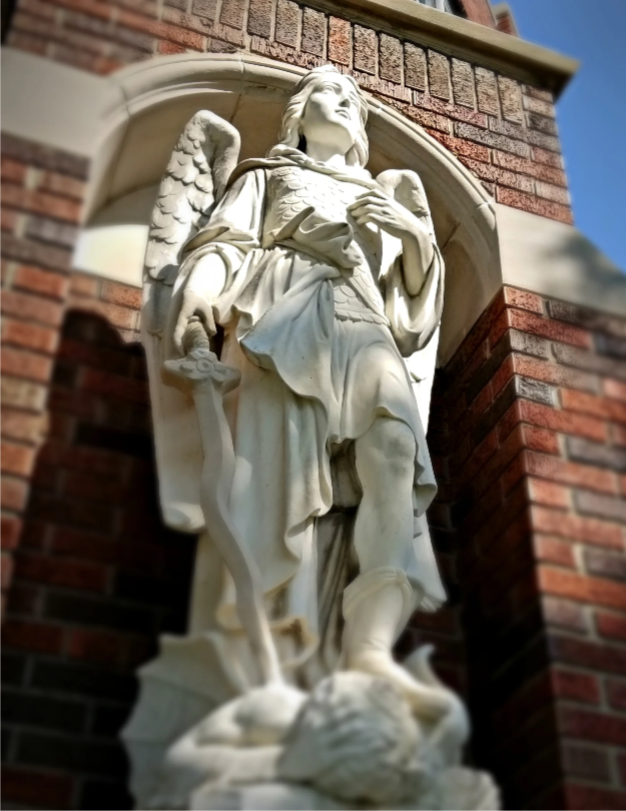
Our Why
We serve all who come to our door for aid not because they’re Catholic, but because we are.
Mission
The mission of Catholic Charities of Shiawassee and Genesee Counties is the work of the Catholic Church, to share the love of Christ by performing the corporal and spiritual works of mercy, namely:
Feed the Hungry
Give Drink to the Thirsty
Clothe the Naked
Shelter the Homeless
Visit the Sick
Visit the Imprisoned
Bury the Dead
Admonish the Sinner
Instruct the Ignorant
Counsel the Doubtful
Comfort the Sorrowful
Bear Wrongs Patiently
Forgive all Injuries
Pray for the Living and the Dead
Vision
Believing in the presence of God in our midst, we proclaim the sanctity of human life and the dignity of the person by sharing in the mission of Jesus given to the Church. To this end, Catholic Charities of Shiawassee and Genesee Counties works with individuals, families and communities to help them meet their needs, address their issues, eliminate oppression, and build a just and compassionate society.
Values
Our core values identify what Catholic Charities, as an organization, stands for and guide how we conduct ourselves as we work in support of our mission to serve all people, regardless of faith. These beliefs guide our day-to-day behaviors and interactions with all those we serve, while reminding us of our purpose to Provide Help and Create Hope. At our core, we believe in compassion, education, family preservation, hope, human dignity, integrity, love and respect.
Catholic Social Teaching
Our mission is rooted in the seven principles of Catholic social teaching listed below.
-
The Catholic Church proclaims that human life is sacred and that the dignity of the human person is the foundation of a moral vision for society. This belief is the foundation of all the principles of our social teaching. We believe that every person is precious, that people are more important than things, and that the measure of every institution is whether it threatens or enhances the life and dignity of the human person.
-
The person is not only sacred but also social. How we organize our society in economics and politics, in law and policy, directly affects human dignity and the capacity of individuals to grow in community. Marriage and the family are the central social institutions that must be supported and strengthened, not undermined. We believe people have a right and a duty to participate in society, seeking together the common good and well-being of all, especially the poor and vulnerable.
-
The Catholic tradition teaches that human dignity can be protected and a healthy community can be achieved only if human rights are protected and responsibilities are met. Therefore, every person has a fundamental right to life and a right to those things required for human decency.
Corresponding to these rights are duties and responsibilities–to one another, to our families, and to the larger society. -
A basic moral test is how our most vulnerable members are faring. In a society marred by deepening divisions between rich and poor, our tradition recalls the story of the Last Judgment (Mt 25:31-46) and instructs us to put the needs of the poor and vulnerable first.
-
The economy must serve people, not the other way around. Work is more than a way to make a living; it is a form of continuing participation in God’s creation. If the dignity of work is to be protected, then the basic rights of workers must be respected–the right to productive work, to decent and fair wages, to the organization and joining of unions, to private property, and to economic initiative.
-
We are one human family whatever our national, racial, ethnic, economic, and ideological differences. We are our brothers’ and sisters’ keepers, wherever they may be. Loving our neighbor has global dimensions in a shrinking world. At the core of the virtue of solidarity is the pursuit of justice and peace. Pope Paul VI taught that “if you want peace, work for justice.” The Gospel calls us to be peacemakers. Our love for all our sisters and brothers demands that we promote peace in a world surrounded by violence and conflict.
-
We show our respect for the Creator by our stewardship of creation. Care for the earth is not just an Earth Day slogan, it is a requirement of our faith. We are called to protect people and the planet, living our faith in relationship with all of God’s creation. This environmental challenge has fundamental moral and ethical dimensions that cannot be ignored.